

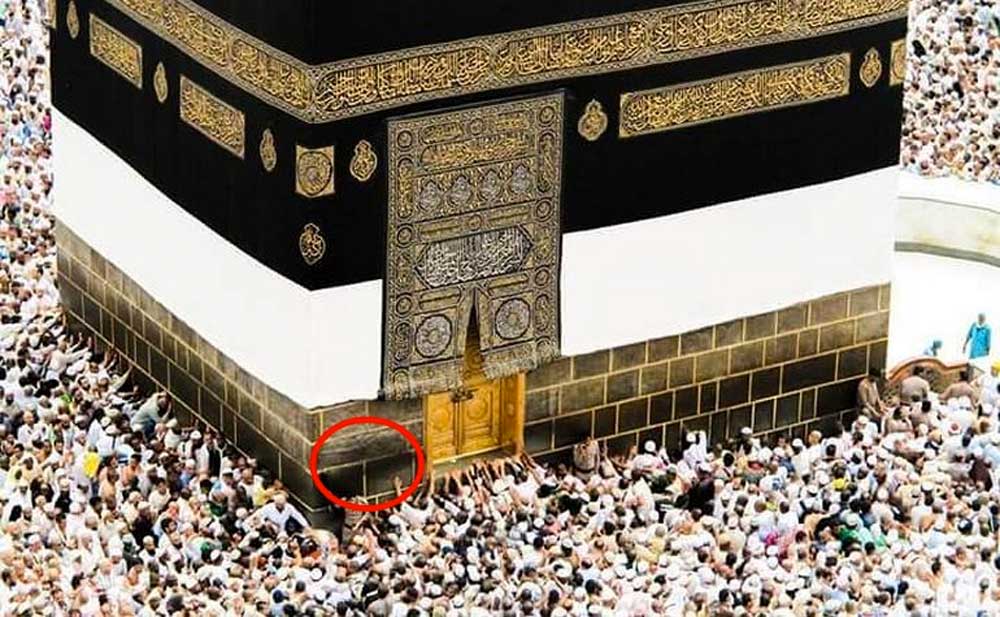
The area between the Hajar al-Aswad and the Door of the Ka’ bah is called the Multazam. It is approximately two metres wide and is a place where du’ as (supplications) are accepted.
Multazam is one of the eight most significant sites, located within the Grand Mosque of Mecca (Masjid Al-Haram). These are the Ka’aba, Hajr-e-Aswad (Black Stone), Maqam-e-Ibrahim (Station of Prophet Ibrahim), the hills of Safa and Marwa, the Zamzam Well, Hateem, Multazam, and Rukn-e-Yemani (the Yemani corner). Multazam and Rukn-e-Yemani are, in fact, a part of the Ka’aba, whereas others are standalone sites around it. However, Hateem is historically considered part of the Ka’aba but was not included within its boundary walls during the 7th-century CE reconstruction.
The site, named Multazam, holds historical, traditional, and, more importantly, significant religious significance in Islam. Every pilgrim likes to make supplications (dua’a) at this site, preferably while touching it with their faces, hands, and chests. It is widely believed among the Muslims that any supplication made while clinging to Multazam is highly likely to be accepted by Allah سُبْحَانَهُۥ وَتَعَالَىٰ, because it is remembered as an act frequently and consistently performed by the Sahaba’a (the companions of the Prophet Muhammad صَلَّى ٱللَّٰهُ عَلَيْهِۦ وَسَلَّمَ).
Multazam (ملتزم) is one of the sacred parts of the walls of the Ka’aba. Multazam is an Arabic word that takes its origin from the Arabic expression “Iltizaam", which translates to "Clinging to. Accordingly, the name given to this particular place can be translated to "the place to cling". Sometimes it is also translated to "a place of attachment". Since the Prophet Muhammad صَلَّى ٱللَّٰهُ عَلَيْهِۦ وَسَلَّمَ and his companions are reported to have made supplications, while pressing their chests, arms, and faces against this part of the wall of the Ka’aba, it got the name “Multazam”.
Multazam is the area on the eastern wall of the Ka’aba, between the Ka’aba door and the Black Stone (Hajr-e-Aswad). If the pilgrims are standing in front of the Eastern wall of the Ka’aba, with their faces towards the door of the Ka’aba, the Black Stone (Hajr-e-Aswad) will be on their right side. The entire part of the wall between the door and Hajj-e-Aswad is referred to as Multazam.
Multazam is approximately 2 meters (6 feet) wide and is part of the Ka’aba wall between the door and Hajj-e-Aswad. However, some scholars hold that the entire Eastern fence is included in Multazam. But the majority consensus is that it is only the two-meter-wide area that falls between the Hajr-e-Aswad and the Ka’aba door.
It is commonly believed among the Muslims that Dua’as (Supplications) made, while clinging to this place, are recognized and accepted by Allah سُبْحَانَهُۥ وَتَعَالَىٰ. Many traditions in Islamic history mention that the Sahaba (companions of the Prophet) and Tabi'een (companions of the Sahaba) used to make supplications while clinging to Multazam, with their faces, arms, hands, and chests touching the wall. However, the scholars are quite clear that doing so is not a compulsory part of Hajj or Umrah.
While traditions regarding this practice among the Sahaba and Tabi'un are available, there is no authentic Hadith reference to its being the Sunnah of the Prophet Muhammad صَلَّى ٱللَّٰهُ عَلَيْهِۦ وَسَلَّمَ. A couple of Hadiths, mentioned in Sunan Abu Dawood, Sunan Ibn Majah, and Masnad Ahmad, in this context, are rated “Da’eef” (weak). Hadith 1898 and 1899, as appearing in Sunan Abu Dawood, narrate this subject, but these are widely considered "Da’eef”.
However, a general consensus exists among historians and Islamic Scholars that it was a consistent practice of the Sahaba and Tabayeen to make Duaas while clinging to Multazam. Hence, the significance of Multazam as a sacred site for supplication is beyond doubt and remains a preferred practice among pilgrims who have the opportunity to visit the site.
However, some authentic Hadiths confirm that the Prophet Muhammad صَلَّى ٱللَّٰهُ عَلَيْهِۦ وَسَلَّمَ did touch the Hajr-e-Aswad and Rukn-e-Yemani (the Yemani Corners). This is narrated in Hadith 1606 of Sahih Al-Bukhari, where it is only mentioned that the Prophet touched the Yemeni Corners and Hajr-e-Aswad, but there is no specific mention of Multazam.
Although it is not a compulsory ritual for Hajj and Umrah, supplication at Mutlazam is considered highly virtuous. Every pilgrim likes to make Dua’as at this spot during pilgrimage to the Ka’aba, whether it is Hajj or Umrah. At the same time, touching or clinging to Multazam demands the highest level of respect and reverence, as it is a part of the holiest site in Islam, the Ka’aba.
Accordingly, the pilgrims should maintain the decorum and sanctity of the Ka’aba while making Dua’as at Multazam. Based on the practices of the Companions of the Prophet, pilgrims must follow the etiquette, as mentioned here:
Although there is no specific ritual for making Dua’as at Multazam, following the practices of Sahaa’ba is the best option, which is as follows:
While there is no specific time designated for supplicating at Multazam, the recommended time is immediately after the completion of Tawaf. Other times considered best for this ritual are:
Remember, supplicating at Multazam, while clinging to it, is not an obligatory part of Hajj or Umrah, though doing so is highly virtuous. Try your best to obtain access to Multazam so you can rely on it for making a Dua’a. If due for any reason, you are unable to do that, try doing the following:
If you do not get a chance to cling to the Wall of Ka’ba, don’t get depressed; you have tried your best. Leave the rest to Allah سُبْحَانَهُۥ وَتَعَالَىٰ as He is All Knowing and Merciful. May Allah سُبْحَانَهُۥ وَتَعَالَىٰ bless every Muslim to get an opportunity to visit the Ka’aba for Hajj or Umrah and supplicate while clinging to Multazam.