

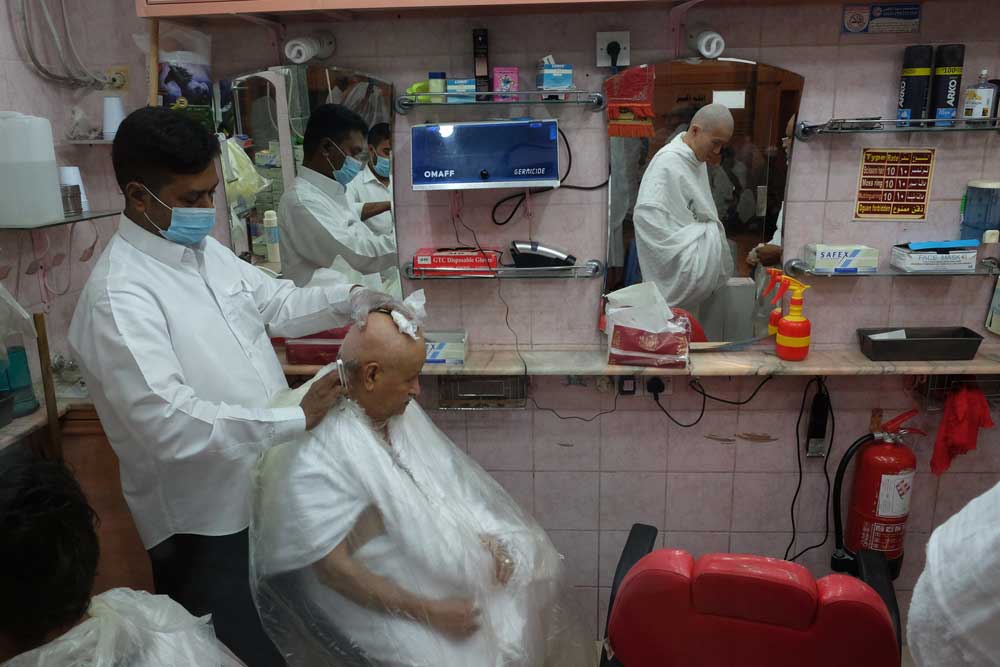
Shaving of the head or clipping of hair is an essential and last part of Hajj and Umrah. It marks the completion of the Hajj or Umrah rituals, after which, the pilgrims are allowed to come out of the state of Ihram. In Islamic terminology, shaving the head or trimming the hair are commonly referred to as “Halq – حلق” and “Taqseer – تقصير”, respectively. Doing so during Hajj and Umrah is made obligatory through the 27th verse of Surah Al-Fath, as follows:
Translation - God has truly made the vision of His Apostle come true: You will surely enter the Holy Mosque in security if God please, without any fear, having shaved your heads and cut your hair. He knew what you did not know, and has vouchsafed you, apart from this, a victory near at hand.
Additionally, there are many Hadiths where the importance and obligation of Halq and Taqseer are specifically mentioned. It is also reported in many traditions as the Sunnah of the Prophet Muhammad صَلَّى ٱللَّٰهُ عَلَيْهِۦ وَسَلَّمَ, such as Hadith 1726 of Sahih Al-Bukhari.
Translation - Allah's Messenger (ﷺ) (p.b.u.h) (got) his head shaved after performing his Hajj.
The obligatory ritual of Shaving the head (Halq) or Clipping hair (Taqseer) is essentially required both at the end of Umrah and Hajj. But the correct timings of performing this ritual differ in both cases, as follows:
When performing Umrah, the obligatory ritual of shaving the head or clipping hair is essentially performed after completing Sa’i (briskly walking seven times between the hills of Safa and Marwa). After the performance of Halq or Taqseer, the pilgrims are allowed to come out of the state of Ihram and wear their normal clothes. It marks the end of the rituals of Umrah.
Correct timings for performing the obligatory ritual of Halq or Taqseer differ with the type of Hajj, as follows:
In both the above cases, the final performance of Halq or Taqseer must be done after the animals have been sacrificed and after stoning the devils. It is also recommended that this final ritual of Hajj should preferably be performed in Mina, though it can also be performed elsewhere within Mecca. On the other hand, Umrah, an essential ritual, can be performed in Mecca.
Although both shaving the head (Halq) and Clipping Hair (Taqseer) are permissible while performing Hajj or Umrah, the ritual of Halq is more virtuous and highly recommended as per the Sunnah of the Prophet Muhammad صَلَّى ٱللَّٰهُ عَلَيْهِۦ وَسَلَّمَ. Hadith 1727 of Sahih Al-Bukhari narrates it as follows:
Translation - Allah's Messenger (ﷺ) said, "O Allah! Be merciful to those who have their head shaved." The people said, "O Allah's Messenger (ﷺ)! And (invoke Allah for) those who get their hair cut short." The Prophet (ﷺ) said, "O Allah! Be merciful to those who have their head shaved." The people said, "O Allah's Messenger (ﷺ)! And those who get their hair cut short." The Prophet (ﷺ) said (the third time), "And to those who get their hair cut short." Nafi` said that the Prophet (ﷺ) had said once or twice, "O Allah! Be merciful to those who get their head shaved," and on the fourth time he added, "And to those who have their hair cut short”
So, shaving off the head is three times more virtuous than clipping hair, as derived from the contents of the above-mentioned Hadith.
Women are not required to shave their heads; instead, they are only required to cut their hair. Hadith 1985 of Sunan Abi Dawood narrates it as follows:
Translation - Shaving is not a duty laid on women; only clipping the hair is incumbent on them.
So, women are only required to perform Taqseer as the final ritual of Hajj or Umrah. The permissible limit of cutting or clipping hair is approximately one inch, or equal to the length of a fingertip.
The scholarly view about Taqseer, i.e., clipping hair, is that:
However, it is better for men to shave their heads, instead of clipping hair, though clipping hair is also permissible for them.
Shaving the entire head or clipping/trimming hair is an essential part of Hajj and Umrah for men, whereas women are only required to cut/trim their hair up to one inch or equal to their fingertips. In any case, it marks the end and completion of all Hajj and Umrah rituals. More importantly for men, completely shaving off the head is highly virtuous as being a Sunnah of the Prophet. After performing this ritual, pilgrims, whether performing Hajj or Umrah, are allowed to exit the state of Ihram and wear their normal clothes. For Hajj, it must be ensured that this important ritual is performed after the slaughtering of the sacrificial animals.
May Allah سُبْحَانَهُۥ وَتَعَالَىٰ accept all our worship, including Hajj and Umrah!